Key messages
- Climate change and human freshwater use are driving massive, accelerating water losses across all landmasses (excluding Greenland and Antarctica), a phenomenon known as continental drying.
- Groundwater loss is currently a critical contributor to global sea level rise. In the past decade, these continental water losses have contributed more freshwater to sea level rise than either the Antarctic or the Greenland ice sheets individually.
- The world is experiencing a fundamental shift in hydrological regimes, where entire regions are transitioning into persistent deficit states driven by intensified evapotranspiration, rising human water consumption, and water resource mismanagement.
- Multi-year droughts (MYDs) are increasing in both frequency and intensity. Unlike seasonal droughts, MYDs create an ecological “debt”: soil moisture and groundwater reserves go unreplenished across successive seasons, escalating threats to forest health, aquatic biodiversity, and food security.
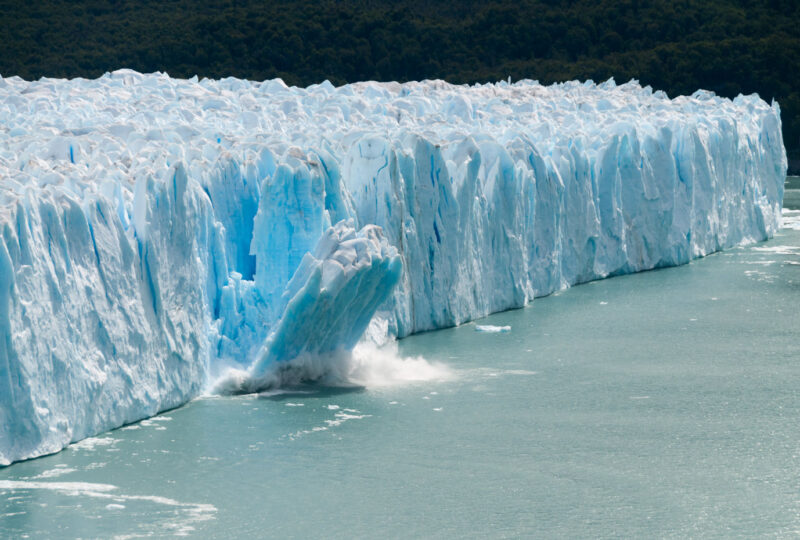
Roughly three-quarters of the global population lives in the 101 countries that have been losing freshwater since 2002. Within continents, water is disappearing from snow, ice, surface water, soil moisture, and groundwater, with much of it ultimately ending up in the oceans. As a result, this reduction in total water storage (TWS) threatens water availability and ecosystem resilience while also contributing directly to sea level rise.
Climate change and direct human activity are driving these massive water losses. Rising temperatures, melting ice, permafrost thaw, and a growing reliance on non-renewable groundwater reserves are all contributing factors (see Insight 5, 2025/2026 edition). New research is shedding light on the mechanisms driving continental drying and pointing to solutions that could mitigate and reverse the trend.
Groundwater loss now contributes roughly as much to sea level rise as melting glaciers and ice caps, accounting for 68% of non-glacier TWS loss. Since 2012, these combined continental losses have contributed more freshwater to sea level rise than the Antarctic ice sheet, and since 2015, roughly as much as, and in most years more than, the Greenland ice sheet. This trend compounds the risk of sea level rise already posed by ice sheet loss alongside thermal expansion and salinity changes (see Insight 2).
Changes are being revealed by NASA’s Gravity Recovery and Climate Experiment (GRACE) and GRACE-FO satellite missions, which track how much water is stored on land by detecting tiny changes in Earth’s gravity caused by shifting water mass. Two decades of data (April 2002–April 2024) show that the continents (excluding Greenland and Antarctica) are drying at an unprecedented rate. A decade ago, the evidence suggested that high- and low-latitude wet areas were getting wetter, while mid-latitude dry areas were getting drier. New findings overturn part of that picture: only the tropics are still getting wetter. The rapidly warming high latitudes are now losing water, as snow and ice melt and permafrost thaws, resulting in “mega-drying” regions across boreal Canada and Russia (Figure 3).
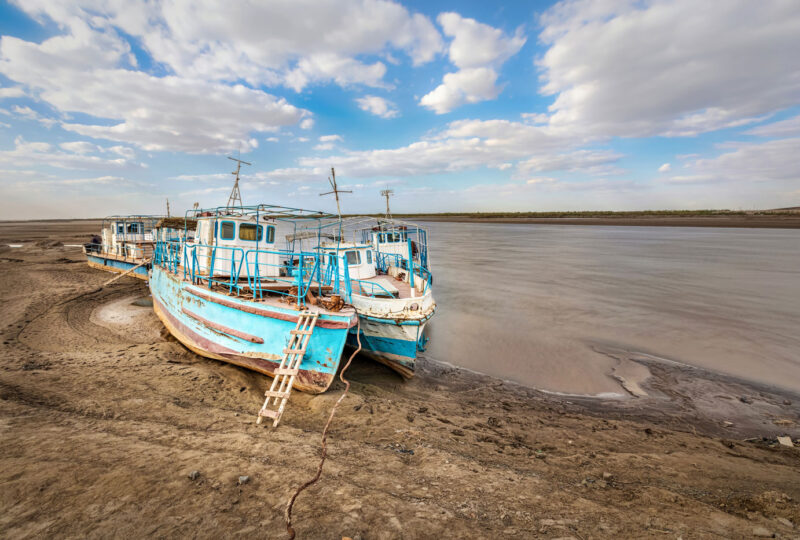
Crucially, dry areas are now drying faster than wet areas are wetting, and the area of land shifting to a drying trend is expanding by roughly twice the size of California every year. As a result, two additional mega-drying regions are emerging, linking together previously distinct hotspots: southwestern North America and a vast Middle East–North Africa–Pan-Eurasia belt. Both are driven by aridification (rising potential evapotranspiration) and excessive groundwater pumping. Together, this drying and the rise in prolonged droughts amount to a hydrological regime change under global warming, one that is increasingly measurable through the concept of water gaps (Box 1).
Beyond this background drying trend, imbalances between rainfall and evaporative demand are also becoming more frequent and intense, fuelling more MYDs. A global inventory identified over 10,000 such droughts between 1980 and 2018, and found that the land area they affect has grown by 49.3 ± 14.8 thousand km² per year, an area larger than Switzerland or the Dominican Republic. Unlike flash or seasonal droughts, which unfold quickly and end within months, MYDs create a lasting ecological debt: soil moisture and groundwater reserves struggle to recover across successive seasons under persistent drying and rising demand. The threats can escalate, leading to tree mortality (with effects varying by biome) and drought-driven loss of aquatic biodiversity. The impacts of prolonged droughts grow disproportionately compared to short-term droughts, increasing the risk of pushing Earth past planetary boundaries for climate, biosphere integrity, and biogeochemical flows.
These water gaps are tracked across major irrigation regions at decadal resolution. Multi-model analyses show that unsustainable irrigation, meaning irrigation that depletes groundwater and environmental flows, is already concentrated in South Asian hotspots including the Ganges, Sabarmati, and Indus, with further intensification projected there and across the US High Plains; the Nile Delta stands out for its high pressure per unit of irrigated land. This has cascading effects for agriculture, energy, ecosystems, and socio-economic and political stability within and across countries. Unlike traditional water-scarcity indicators, the water gap framework quantifies the volume of unsustainable use, revealing where adaptation needs are greatest and where mitigation is most urgently required.
These findings can translate directly into actionable solutions. Estimating water gaps helps decision-makers gauge the scale of intervention required. A portfolio of measures is needed: on the supply side, this includes potable water reuse, desalination, managed aquifer recharge, and enhanced storage; on the demand side, more efficient industrial and agricultural water use, and siting water-intensive activities where resources are more abundant. Managed aquifer recharge alone, capturing surplus floodwater and channelling it back underground, could offset 4–6% of unsustainable irrigation globally.
Tackling the issue of continental drying represents a critical nexus of climate change, human activity, and water security. Consequences of inaction extend from threats to local livelihoods to cascading impacts for planetary systems.
Box 1. Globally, water gaps are growing
A water gap is the mismatch between how much water people consume and how much is renewably and sustainably available: water that comes from a renewable source and still leaves enough for ecosystems to function. A recent global assessment found that human water consumption already exceeds sustainable availability by 458 km³ a year, roughly equivalent to the total annual water withdrawals of the USA or India. This gap will not remain fixed: it will grow disproportionately with warming, increasing by around 6% at 1.5°C and 15% at 3°C, with strong regional variation. That nonlinear growth suggests some regions might transition into persistent deficit states driven by altered precipitation patterns, intensified evapotranspiration, and rising water consumption.
Policy implications
- Monitor terrestrial water-storage decline and water gaps. Parties should integrate terrestrial water storage trends (TWS) and basin- or aquifer-level supply–demand gaps into NAP monitoring, evaluation, and learning systems. These measures would complement the Belém Adaptation Indicators on water stress, water-use efficiency, and access, supporting implementation of the UAE Framework and advancement of the GGA. COP31’s Global Climate Action Agenda (GCAA) could further catalyse action on water-availability risks through its Food Security and Clean Energy tracks.
- Recognise slow-onset freshwater depletion within loss-and-damage institutions and responses. The FRLD should operationalise support for economic and non-economic losses arising from climate-related groundwater decline, prolonged drought, freshwater salinisation, and associated ecosystem degradation. Support could cover assessment, response planning, rehabilitation where feasible, and irreversible or residual losses. The Santiago Network could provide technical assistance for hydrological monitoring, attribution-informed assessment, loss accounting, identification of adaptation limits, and funding-proposal preparation.
- Elevate awareness about climate-related transboundary water risks. As the impacts of climate change on freshwater resources become more acute, historical allocation rules may become increasingly unreliable. Advancing on the SDG indicator 6.5.2 and in accordance with the UAE Framework’s recognition of climate-informed transboundary management, neighbouring governments should collaborate through basin organisations, to strengthen joint monitoring, adaptable allocation and withdrawal rules, environmental-flow protections, and coordinated drought planning. The UN Water Convention provides a general framework, and the UNESCO Intergovernmental Hydrological Programme and the International Groundwater Resources Assessment Centre can provide technical support.
- Build strategic drought reserves and prepare demand management plans for prolonged drought. When conditions are suitable, water authorities should consider investing in managed aquifer recharge systems that capture suitable wet-period flows or treated wastewater for underground storage and recovery during prolonged drought. These can be coupled with staged drought-management plans that trigger restrictions, reallocation, and conservation measures as water availability declines, protecting essential human needs and environmental flows.
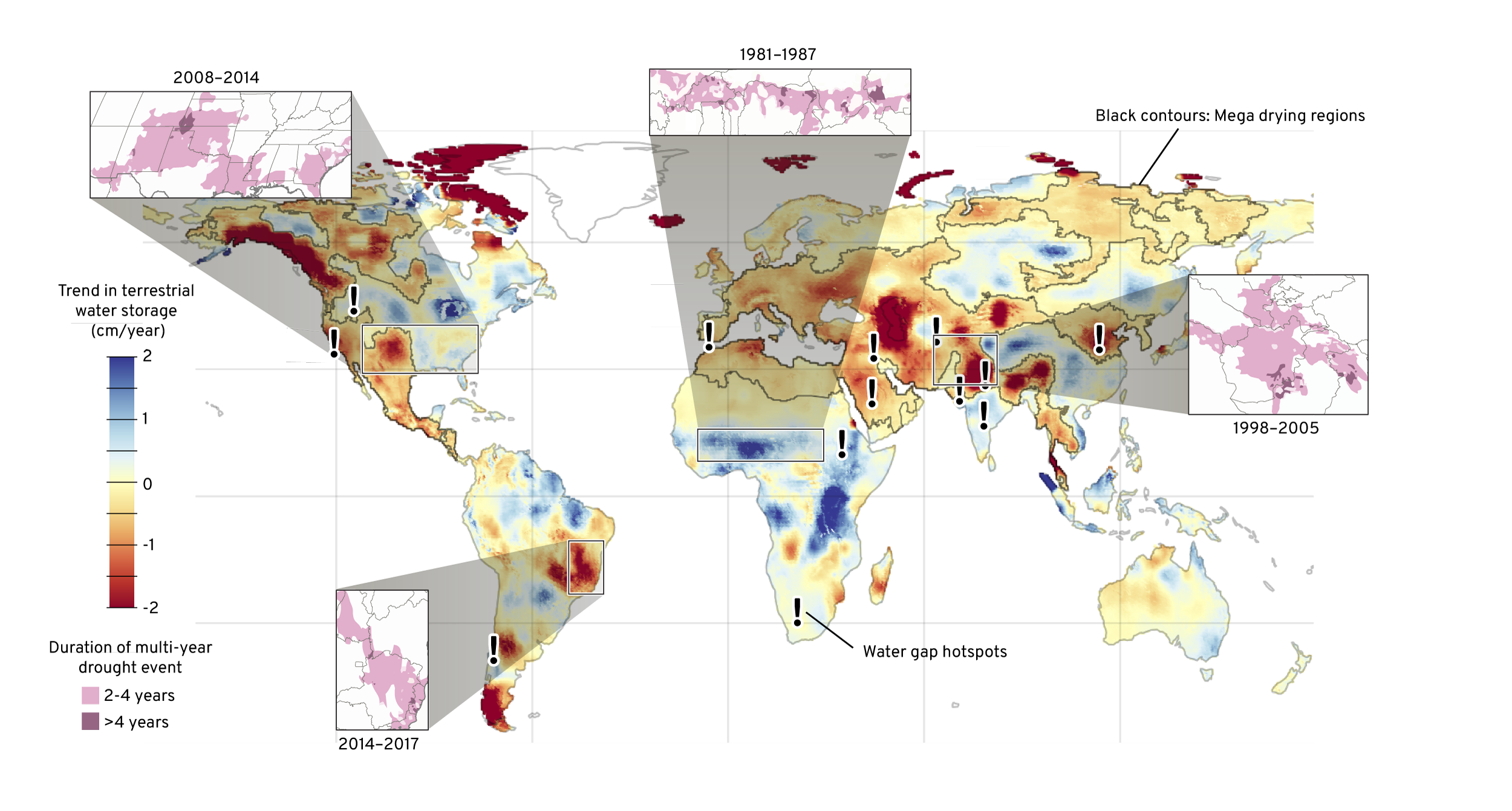
Red and blue shading shows long-term (2004–2024) TWS trends from GRACE and from human water consumption,1 resulting in water gaps. Pink symbols indicate modelled water gaps for 2001–2010, where consumption exceeds renewable water availability.2 Water gaps can occur in regions of long-term drying, but in some instances also in wetting regions, driven by high consumption. Of the top MYD events from 1980–2018, some occurred in regions of long-term drying, and some in regions that are overall getting wetter.3 These selected examples highlight the complex nexus of climate change, human activity, and water security, with water depletion (and its opposite) resulting from both direct human influence and indirect climate effects, alongside natural variability.
- Chandanpurkar, H. A., et al. (2025). Unprecedented continental drying, shrinking freshwater availability, and increasing land contributions to sea level rise. Science Advances, 11(30), eadx0298. ↩
- Rosa, L., & Sangiorgio, M. (2025). Global water gaps under future warming levels. Nature Communications, 16(1), 1192. ↩
- Chen, L., et al. (2025). Global increase in the occurrence and impact of multiyear droughts. Science, 387(6731), 278–284. ↩