Key messages
- The social cost of carbon (SCC) has been significantly underestimated in widely used climate-economy models. Integrating state-of-the-art Earth system models yields estimates up to four times higher.
- Specifically, incorporating ocean-based systems, including marine ecosystems, fisheries, and marine infrastructure, nearly doubles the SCC compared to estimates that exclude them. Similarly, accounting for additional urban heat island effects can more than double the global SCC.
- New models linking GDP growth to weather variability and global mean temperature project substantially higher future economic losses, implying greater macroeconomic sensitivity than previously estimated.
What does an additional tonne of CO₂ really cost the world? Economists rely on a key metric, the SCC, which influences everything from national carbon prices to the economic case for climate action itself (Box 4). New research indicates that conventional approaches to calculating the SCC may significantly underestimate true costs, often because they oversimplify how a warming planet damages economies and ecosystems over the long term. The more we understand about the myriad connections between the physical, ecological, and economic worlds, the more our estimates of the true cost of carbon keep climbing (Figure 6). A more complete picture of the SCC can inform decisions about mitigation versus adaptation and guide climate investments that deliver the greatest long-term return.
In practice, climate damage estimates draw on a spectrum of approaches. At one end are structural models, which simulate how climate change would ripple through markets and the wider economy. At the other end are more empirical approaches, increasingly common in the literature, where researchers look directly at historical data to see how past weather, including extreme events and year-to-year variability, has affected economic outcomes, and then use those statistical relationships to project future damages. These estimates feed into integrated assessment models, which link today’s emissions to future climate change, economic impacts, and ultimately, the SCC itself.
When recent insights are incorporated into these models, estimated climate damages increase markedly. One key finding is that including global average temperature, not just local weather, in these statistical models leads to much higher projected GDP losses. The effect is substantial. Research shows projected economic losses under high-warming scenarios by 2100 jumped from around 11% to around 40% of GDP on average. According to this model, the cost of further mitigation would outweigh the damage it prevents at anything above 1.7°C, which is in line with the Paris Agreement targets. Separate research points to something equally striking. Using more realistic, up-to-date climate models, rather than the simplified versions built into most economic models, can change the SCC by up to four times over. The choice of climate model, therefore, matters just as much as the choice of economic model.
Climate impacts on ecosystems that do not carry an immediate price tag are also increasingly factored in. Accounting for the benefits provided by marine ecosystems, fisheries, and maritime infrastructure, collectively known as ocean-based welfare, nearly doubles the SCC relative to estimates that leave these sectors out. Cities are also affected. Surfaces like concrete and asphalt can trap heat, pushing up cooling costs, reducing productivity in hot conditions, and straining public health systems. Once this urban heat island effect is factored into economic assessments in addition to global warming, the estimated damage per tonne of CO₂ rises from USD 187 to USD 490. In everyday terms, this means the economic loss from burning a single litre of petrol increases from USD 0.44 to USD 1.14. As urban populations continue to grow, cities are set to bear the brunt: they are projected to account for 78–93% of all global climate-related damages.
Recent country-level work tells a similar story. One major modelling effort, covering more than 50 regions worldwide (RICE50+), puts the 2025 global SCC at about USD 194 per tonne of CO₂, assuming the world follows an efficient, well-coordinated climate policy. Under the business-as-usual scenario, that figure jumps to about USD 437 per tonne. These figures are not directly comparable, but they indicate the scale of the risk. Of course, this does not mean that mitigation is free, but it does mean that money spent cutting emissions now would avoid far larger damages later if warming goes unchecked. That conclusion is reinforced by separate research showing that much of the disagreement between SCC estimates comes down to how the models are built, not just the data behind them.
It is also important to understand how damages are distributed across time, place, and sector. A single global figure can mask real differences in exposure and vulnerability, which matters for how the SCC is used in policy and investment decisions. Future damages caused by past emissions are estimated to be an order of magnitude larger than the damages those emissions have caused so far. This strengthens the case for updating carbon-price benchmarks, while underlining that national valuations can inform domestic policy but cannot substitute for coordinated international action. Climate stability is a shared global good.
Taken together, the evidence points to sobering findings. Emerging research that links human and natural systems more closely shows that the SCC is greater than we thought (Figure 6). Models that capture interconnections between economic and climate systems project far worse GDP damages at moderate to high warming, while models that truly account for uncertainty find that every extra tonne of CO₂ carries additional risk. As understanding of the SCC continues to grow, so should the ambition and urgency of decarbonisation.
Box 4. Defining the social cost of carbon
The SCC measures the economic cost to society of emitting one additional tonne of CO₂. It is typically expressed as the net present value of the total climate damage that tonne will cause over time. These damages include external costs borne by society, such as impacts on property, health, agricultural and labour productivity, the environment, and the broader economy. The SCC matters for climate policy because it allows the benefits of emissions reductions to be compared with the costs of regulation or mitigation.
Policy implications
- Higher SCC estimates strengthen the economic case for earlier and deeper emissions reductions by showing that conventional assessments omit or understate important damages. This is crucially important during the information-gathering phase of the GST2, which begins now. The 2035 NDCs should translate into funded sectoral implementation plans, and ambition should reflect a more robust understanding of the damages associated with additional greenhouse gas emissions and further global warming. Under Article 6, participating Parties should separately ensure environmental integrity and avoid prices that discourage higher-cost mitigation.
- Update carbon values for other public decisions. This includes those used by national governments and MDBs, which should reflect updated understanding of the “shadow carbon values”. This is significant for regulatory assessments, budgets, procurement, and infrastructure appraisal. Methodologies should account for global and intergenerational damages, spatial inequalities, non-market impacts, and uncertainty, rather than relying on a single central estimate.
- Scale climate finance using updated damage evidence. Parties, developed-country contributors, MDBs, and climate funds should use updated evidence on climate damages to strengthen the case for more grant-based, concessional, and non-debt-creating finance. This evidence should inform implementation of the Baku-to-Belém Roadmap, including efforts to scale finance for developing countries towards the aspirational figure of USD 1.3 trillion annually by 2035. The Board and contributors to the FRLD should also consider updated damage evidence when assessing needs and preparing the Fund’s first replenishment, starting in 2027.
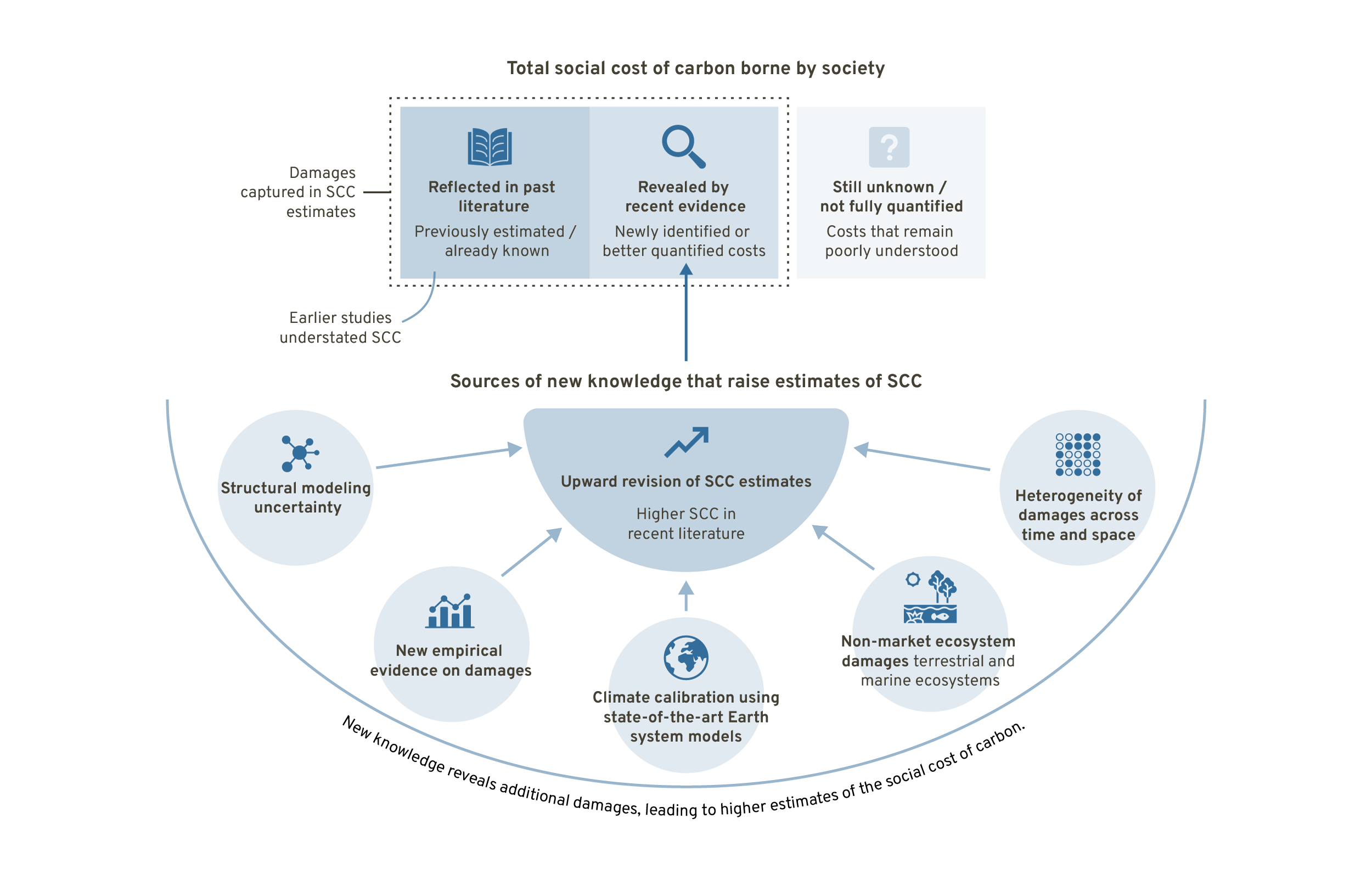
New empirical evidence on climate damages, improved climate calibration, better treatment of structural uncertainty, and broader valuation of non-market, spatial, and temporal impacts support upward revisions to the SCC.