Key messages
- Climate clubs and club-like arrangements have been proposed to address carbon leakage and carbon pricing disparities across countries. These arrangements leverage market power, trade rules, and exclusive benefits to incentivise participation and make ambitious climate action more politically and economically viable.
- Carbon border adjustment mechanisms (CBAMs) are emerging as influential governance instruments that can reduce carbon leakage and encourage global climate policy convergence. However, their effectiveness depends on careful design that addresses trade law and the disproportionate impact on low-income countries.
- Fairness is key to the feasibility and effectiveness of these arrangements and essential for avoiding unintended consequences across trade, emissions, and development.
To drive deep carbon reductions at scale, the rules of global trade need to keep pace. One major challenge to address is carbon leakage, in which firms import from or relocate production to jurisdictions with weaker carbon policies, simply shifting emissions to another part of the world.
Today, we are at a critical moment. On the one hand, leakage incentives are declining as carbon-pricing mechanisms emerge and the gap in country emission intensities narrows. On the other hand, substantial disparities in carbon prices persist, even among countries that have implemented carbon pricing (Figure 8). Left unaddressed, leakage and competitiveness concerns can undermine support for ambitious carbon pricing. One trend that could help address these issues is the rise of climate clubs and club-like arrangements.
The concept of climate clubs carries multiple meanings. At the more ambitious end are transformational clubs, which grant exclusive benefits, such as trade privileges or access to technology for members that meet climate commitments (potentially imposing costs on outsiders). In this Insight, we assess the potential of the transformational club type conceptualised by Nobel Prize–winning economist William Nordhaus.
The IPCC Sixth Assessment Report (AR6) concluded that climate clubs could accelerate mitigation, while noting that real-world examples remained limited. Research since AR6 broadly splits into two camps: theoretical and model-based studies assess the effectiveness of mitigation, trade leverage, participation incentives, and legitimacy, while design-oriented studies and analyses of existing initiatives examine the gap between idealised potential and practice.
Given the shortage of real-world climate clubs, we can look to examples in other environmental areas. A high-profile example is the Montreal Protocol, which regulates the production and consumption of ozone-depleting substances. This landmark agreement achieved near-universal participation, illustrating how restricting trade privileges to parties can incentivise accession and higher standards. Elsewhere, in the fisheries sector, evidence suggests that clubs succeed when monitoring is credible and benefits are tangible. Agreements that incorporate trade provisions attract more accessions and undergo more frequent regulatory upgrades.
To date, there is no comprehensive climate club that combines high ambition with extensive global participation. However, various existing initiatives and policy proposals exhibit club-like features. Examples include the Agreement on Climate Change, Trade and Sustainability (ACCTS), the proposed EU–US agreement on low-carbon steel and aluminium, and proposed versions of a fossil fuel non-proliferation treaty. Although these examples differ in design, they all link stronger climate commitments to excludable benefits, most commonly through trade measures with participation incentives.
Another avenue is the inclusion of climate provisions in broader trade agreements. Although conceptually distinct from climate clubs, they also incentivise decarbonisation by linking trade benefits to climate commitments. Preferential trade agreements, especially those the EU negotiates, increasingly embed commitments linked to the Paris Agreement and fossil fuel subsidies. Beyond politics, investment agreements increasingly include climate-related clauses.
To date, the consequences of climate-related provisions in trade agreements are mixed. If well designed and enforced, they can shift trade towards cleaner exports, support firms’ green transition, and increase energy efficiency. However, trade liberalisation often relocates pollution, rather than eliminating it, and low-income countries often remain excluded from low-carbon technology. Climate provisions also do little to promote additional climate cooperation, as governments have paid limited attention to these commitments when implementing economic agreements.
More broadly, trade agreement rules can limit governments’ legal capacity to grant decarbonisation subsidies, pursue green industrial policy, and mandate fossil fuel phase-outs. Adding additional constraints risks deepening global climate inequalities, given that climate policies rely on state intervention and institutional quality. In response, economists have proposed new forms of climate clubs that would create greater policy space for participating states by relaxing or modifying constraints imposed by international economic law, or by coordinating industrial policies among club members.
Though not a climate club in the strict sense, carbon border adjustment measures are gaining ground globally as a tool to counter carbon leakage. The EU’s CBAM, fully operational since January 2026, requires importers of select energy-intensive goods to purchase certificates that match the EU carbon price, while accounting for carbon prices already paid abroad. This aligns import costs with those of EU producers and discourages firms from relocating solely to avoid it. Critics have raised concerns about CBAM’s unilateral governance and whether it conflicts with World Trade Organization rules, with several countries formally challenging the measure. Nevertheless, attitudes to CBAM have evolved from early controversy towards more nuanced, practice-based acceptance.
Early studies suggest CBAM’s direct effects on emissions appear modest, though the mechanism may support climate ambition indirectly by reinforcing EU carbon pricing and encouraging other countries to adopt carbon pricing of their own. Concerns remain, however, that it could amplify existing global inequalities. Developing countries face a “triple burden” of compliance costs, weaker institutions, and social inequality, which could widen carbon-trade divides unless paired with financial transfers or differentiated treatment.
In summary, early examples of club-like climate arrangements reveal a gap between theoretical expectations and messy real-world implementation. The concepts are promising, but we need to avoid unintended consequences across trade, emissions, and development. Future research should integrate Global South scholars’ perspectives more deeply and examine alternative designs. Ultimately, climate clubs and border adjustment mechanisms will only gain global approval if they are fair.
Policy implications
- Anchor climate clubs in Paris Agreement implementation. Participating governments and governing bodies should align club mandates and work programmes with members’ NDCs and long-term strategies, maintain transparent, open accession criteria, and present concrete sectoral deliverables. This would position clubs as voluntary implementation vehicles within a “two-tier multilateralism”, where UNFCCC consensus sets direction and legitimacy, while smaller coalitions advance issues that consensus cannot yet resolve, recognising that success depends as much on ambition as on how the costs and benefits are distributed.
- An appropriate space to showcase club-based industrial cooperation could be the green-industrialisation track under the GCAA, one of the ten COP Presidency-defined priority themes for 2026.
- Combine positive incentives with interoperable carbon accounting. Climate clubs should embed concessional finance, technology cooperation, and coordinated demand for low-emissions materials alongside comparable emissions-accounting methods, support for monitoring, reporting and verification, and quality-infrastructure capacity in developing economies.
- The Climate Club, launched at COP28, is an open intergovernmental forum focused on industrial decarbonisation. It is well placed to support the adoption of interoperable accounting standards for low-emissions materials. Through its Global Matchmaking Platform it matches requests from developing economies with technical and financial support.
- Embed distributional safeguards and international revenue recycling in CBAM design.
- Jurisdictions implementing CBAMs should assess distributional impacts, including trade exposure, compliance costs, employment effects, and institutional capacity, before implementation and at regular review points. These assessments should inform adjustments to CBAM design and targeted support for affected countries.
- To foster fairness and effectiveness, a defined share of CBAM revenue should be earmarked for affected country partners or appropriate multilateral funds, rather than retaining it entirely as domestic revenue to finance emissions measurement and verification, clean energy, and industrial upgrading. This will support affected exporters’ compliance with CBAM requirements and decarbonise production.
- Institutionalise dialogue and accountability on climate–trade interactions. UNFCCC Parties should use the 2026–2028 Climate and Trade Dialogue series, mandated at COP30, to examine how trade can support climate action. Parties should address tensions surrounding measures such as CBAMs and green industrial subsidies, including friction over perceived unilateral measures, as illustrated by BRICS opposition to the EU CBAM.
- The outgoing and incoming COP Presidencies could link these formal discussions with practical cooperation under the Integrated Forum on Climate Change and Trade, launched at SB64 in Bonn, and will reconvene at COP31.
- Parties can also request that the Response Measures Forum and its Katowice Committee of Experts assess the cross-border economic, employment, and distributional effects of climate-related trade measures to inform relevant UNFCCC decisions and the implementation of the just transition.
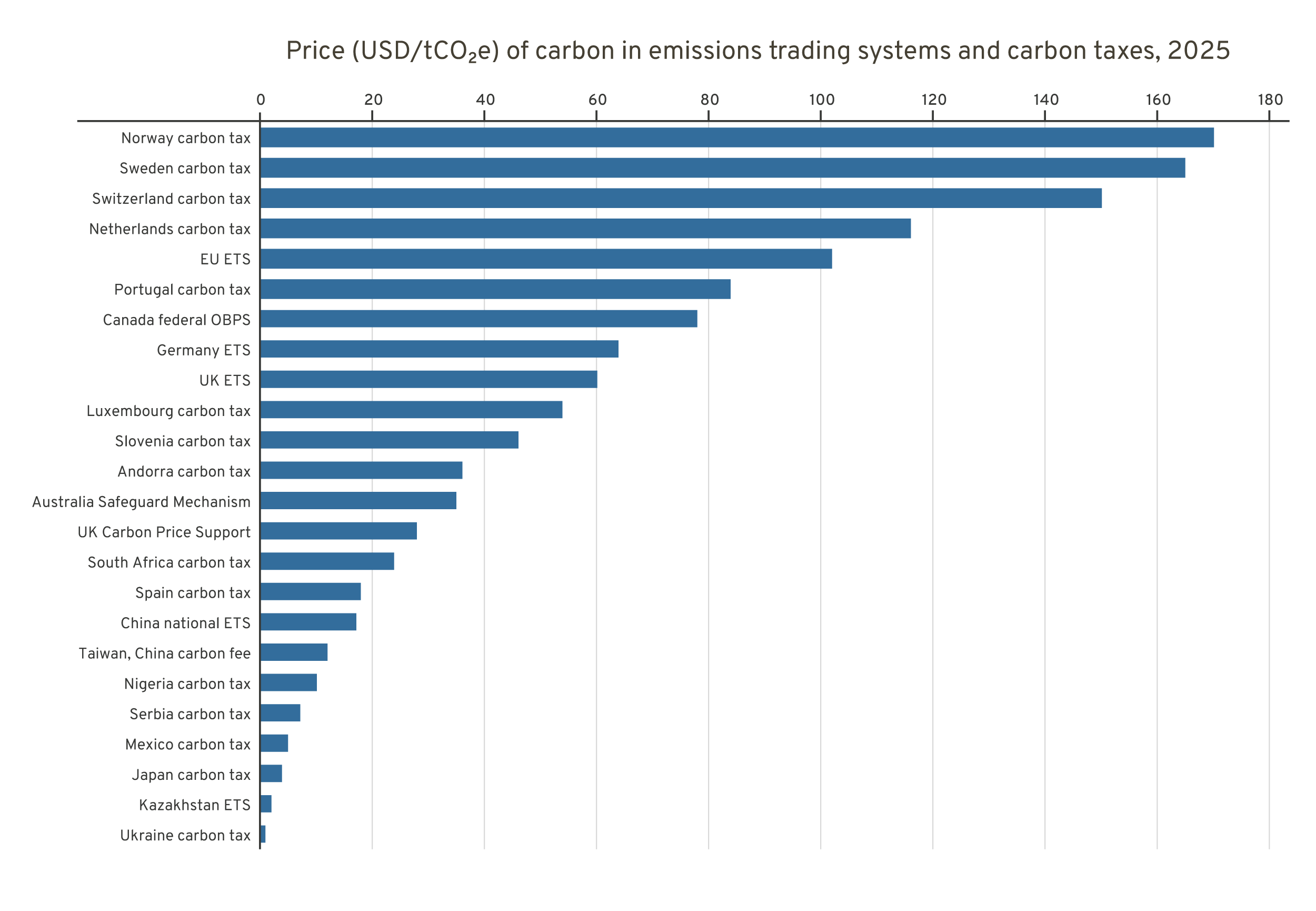
Carbon prices (USD/tCO2e) across jurisdictions with operational carbon pricing instruments as of 2025. Significant price disparities persist. Source: World Bank. (2026). Carbon Pricing Dashboard. https://carbonpricingdashboard.worldbank.org/dashboard