Key messages
- Even if global warming were successfully returned to 1.5°C, some physical impacts are likely irreversible, particularly in slow-responding systems such as the ocean, glaciers, permafrost, and ice-sheets.
- The feasibility and effectiveness of adaptation measures decline as the magnitude of exceedance and duration of an overshoot increase, with hard and soft adaptation limits increasingly being reached.
- Limiting the magnitude of overshoot requires a rapid acceleration of mitigation efforts, retaining the goal of reaching at least net-zero CO₂ emissions globally by mid-century. Limiting the duration of overshoot will require a combination of mitigation strategies, including greatly scaling up CDR, which entails trade-offs with biodiversity, food security, energy, and water.
According to the latest science, limiting end-of-century warming to 1.5°C will require a temporary overshoot before temperatures are brought back down. But heating the Earth is not like changing the thermostat in a house, where conditions soon return to their previous state. It is closer to heat exhaustion tipping into heatstroke: once the body’s core temperature crosses a critical threshold, cells and organs can be severely damaged – and cooling back down does not undo that harm. Beyond 1.5°C, components of the Earth system may enter fundamentally new states, and extra energy in the system could exacerbate climate risks even as temperatures dip. As we approach the impending transgression of 1.5°C, it is critical to understand the consequences of temperature overshoot and to keep it as small and short-lasting as possible (Figure 4A).
Human-induced global warming reached 1.37°C in 2025, and at the current rate, we will pass 1.5°C around 2030. Returning to 1.5°C will require more than achieving global net-zero CO₂. It will require an increasing number of countries to set quantitative net-negative greenhouse gas emission targets beyond 2050 (Figure 4B), alongside policies capable of delivering such outcomes. At the same time, beyond 1.5°C, adaptation needs will further increase and, in some cases, become impossible to meet. Adaptation limits will be reached and losses and damages will accumulate.
Irreversibility is particularly likely in slow-responding components of the climate system, such as the ocean, glaciers, permafrost, and ice sheets. Sea level rise is a clear example. Thermal expansion and glacial retreat drive a rise that persists for centuries, even after surface temperatures decrease and stabilise following overshoot. The magnitude and duration of the overshoot determine the severity of these lasting changes, which ripple out into coastal flood damage, agricultural losses from saltwater intrusion, and lost cultural heritage.
Even when global averages appear to show recovery, they may still mask regional legacies that affect people and ecosystems (Box 2). For instance, exceeding and then reversing 1.5°C generally enhances high-latitude warming and suppresses low-latitude warming, and these regional patterns will reverse more slowly than the global average. In the Arctic, this dynamic could feed a vicious cycle, intensifying further ice loss and permafrost thaw, even after global temperatures start to decline. Globally, climate-related risks to biodiversity can outlast peak warming, potentially affecting livelihoods and economic activities for decades, e.g., through reductions in fish stocks.
The response should be science-backed adaptation that accounts for long-term climate risks, especially for long-lived infrastructure. In practice, this means planning for potential peak warming levels rather than the eventual 1.5°C stabilisation goal, since building for peak conditions proves more cost-efficient, particularly for nature-based solutions and early-warning measures. We need flexible designs that can adapt as risks evolve.
Take sea level rise as an example, since the already-committed rise is irreversible on human timescales. Costly measures such as seawalls, dikes, and levees can reduce risks over long timescales, but as sea levels keep rising, during overshoot and even after a return to 1.5°C, adaptation limits – points at which risks become intolerable – will increasingly be reached. Once limits are reached, protective measures cease to work, coastal areas become uninhabitable, and livelihoods are lost. These knock-on effects can compound across sectors, ecosystems, and communities, deepening vulnerability and disproportionately affecting those least prepared to cope. Exceeding 1.5°C will also make the relationship between warming and its impacts less predictable, bringing unforeseen additional challenges. The reality is that adaptation will become increasingly difficult and can only be effective up to a point.
So, how can we effectively reduce temperatures once the 1.5°C limit is exceeded? Doing so requires three mitigation strategies working together:
- Further reducing residual CO₂ emissions;
- Further upscaling CDR beyond what is required for net zero;
- Cutting residual methane emissions.
Each measure carries substantial challenges. One widely modelled CDR method, bioenergy with carbon capture and storage (BECCS), illustrates why: it involves growing crops or trees, burning them for electricity, then capturing and burying the resulting CO₂ underground. Deploying BECCS at scale means converting vast areas to bioenergy crops, raising sustainability challenges linked with freshwater use, biodiversity, and competition for land used for food production. Assuming the easier-to-abate methane sources from fossil fuel extraction and use are addressed by mid-century, further methane cuts will require reducing emissions from livestock, which would entail dietary changes and may affect rural livelihoods.
Crucially, if peak warming exceeds 1.8°C, a return to 1.5°C by 2100 may no longer be achievable. This would force greater reliance on CDR and heighten the risks that come with it. Given these challenges, the further we edge past 1.5°C, the greater the risk of irreversible damage and sustained, long-term elevated temperatures. Policies and frameworks that can achieve and sustain net-negative emissions within a just transition will take time and sustained political will. Therefore, understanding overshoot legacies, reversal requirements, and adaptation needs is essential to shaping these long-term, science-based strategies. Because of these deep uncertainties and challenges, rapid and deep emissions reductions remain the most urgent priority.
Box 2. Overshoot legacies and tipping points
Temporarily exceeding critical thresholds can produce lasting impacts that persist beyond the overshoot period. Ecological systems are also vulnerable to overshoot legacies. In a warmer Arctic, ice loss and permafrost thaw can intensify even after global temperatures decline, causing irreversible consequences for ecosystem integrity. Ecological tipping point risks increase with overshoot magnitude and duration, with coral reefs and Amazon forests particularly vulnerable to interacting pressures.
A rise in heat-related mortality is the starkest irreversible human impact. Repeated droughts and other forms of extreme weather are likely to weaken food security, leading to malnutrition, which in turn results in multigenerational effects on health, human development, and income. Meanwhile, continuing sea level rise will force more permanent retreats from coastal areas. A world that returns to 1.5°C after decades spent above it will bear more human and environmental damage than one that never crossed the threshold.
Policy implications
- Align climate targets with the full overshoot–peak–decline pathway. GST2 should assess whether collective emissions pathways are sufficient to limit peak warming and enable a return towards 1.5°C. Parties should strengthen successive NDCs for rapid, economy-wide greenhouse-gas reductions, align long-term strategies with global net-zero CO₂ around mid-century, and adopt post-net-zero targets that contribute to sustained global net-negative emissions. To operationalise these targets, Parties should report gross emissions, residual emissions, and gross removals separately, with quantified milestones and timelines. This transparency would expose excessive reliance on removals and clarify whether national pathways collectively limit the magnitude and duration of overshoot.
- Limit overshoot through immediate emissions cuts and planning beyond net zero. Parties should combine deep cuts in gross emissions, including a rapid transition away from fossil fuels and deep methane reductions with quantified targets and timelines. These measures are essential for limiting peak warming. To shorten overshoot, long-term strategies should extend beyond net zero, specifying further reductions in residual emissions, CDR deployment, and contributions to sustained global net-negative emissions. CDR cannot justify delaying deep decarbonisation; given its costs and environmental and social trade-offs, it should counterbalance hard-to-abate residual emissions and contribute to subsequent atmospheric carbon drawdown, not substitute for stringent emissions reductions. Financial resources should therefore be redirected from new fossil-fuel and emissions-intensive infrastructure to low-emission alternatives, avoiding further carbon lock-in.
- Establish coordination mechanisms tailored to the risks and limits of different CDR methods. GST2 should assess CDR’s collective role in post-net-zero pathways, including feasible and sustainable deployment ranges, mitigation-deterrence risks, equity, and support needs. For removals credited under the Paris Agreement Crediting Mechanism, the Article 6.4 Supervisory Body should continue reviewing methodologies and safeguards covering quantification, additionality, leakage, storage durability, and reversals. Parties should establish compatible national frameworks for all CDR counted towards NDCs and long-term strategies, separately reporting emissions and removals and addressing lifecycle emissions, monitoring, leakage, durability, reversals, liability, and grievance procedures. These frameworks should reflect method-specific risks and safeguard for social and environmental trade-offs.
- Plan adaptation for peak warming and address unavoidable loss and damage. National and subnational governments should use NAPs, infrastructure standards, and investment appraisals to stress-test long-lived assets against plausible peak-warming scenarios and persistent impacts, rather than assuming that returning to 1.5°C reverses risks. Authorities should prioritise anticipatory investment and use adaptive pathways, monitored decision triggers, and flexible designs, pursuing transformational responses where incremental measures approach their limits. Through the GGA, Parties should track progress under different warming scenarios. At COP31, Parties should strengthen finance, technical assistance, and accessible support through existing loss and damage arrangements for impacts that adaptation cannot prevent.
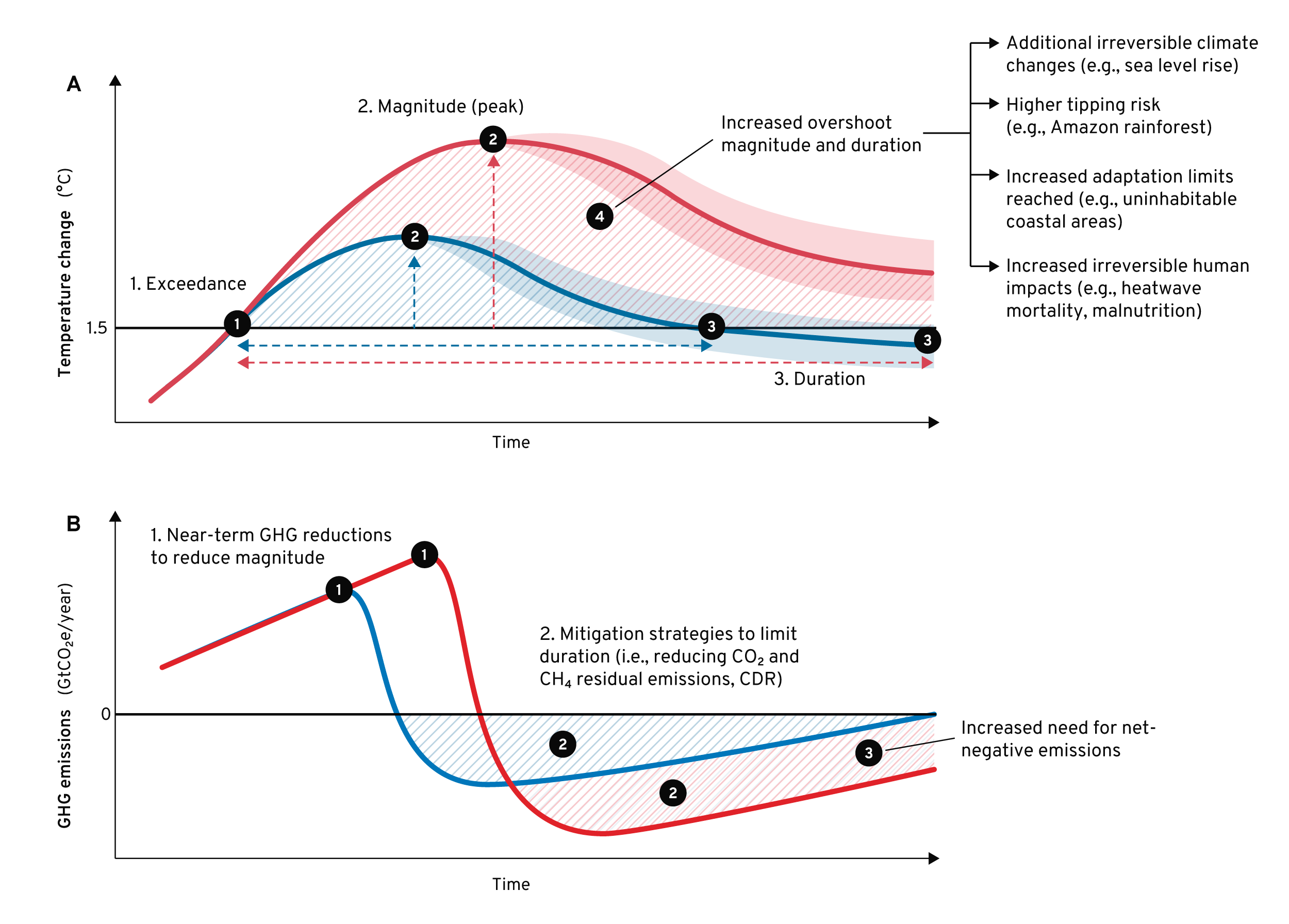
Panel A. Point 1 marks the initial exceedance of 1.5°C, Point 2 indicates the peak warming magnitude above 1.5°C, and Point 3 marks the duration of time spent above the 1.5°C threshold. The red pathway shows a greater overshoot magnitude and a longer duration (Point 4) than the blue pathway, which results in additional environmental and human impacts. Panel B. The panel shows the corresponding global greenhouse gas emissions pathways for the two overshoot pathways. Point 1 highlights that stronger near-term greenhouse gas emissions reductions can reduce overshoot magnitude. Point 2 exhibits mitigation strategies that can shorten overshoot duration after the peak. Point 3 indicates that pathways with larger and longer overshoot imply a greater need for sustained net-negative emissions.