Key messages
- Food systems are the central nexus connecting human health, Earth system processes, and social justice. Generating roughly 30% of human-driven greenhouse gas emissions, food systems are the leading driver of multiple planetary boundary transgressions. Transforming how food is produced and consumed is essential to achieving climate resilience, biodiversity protection, and fair livelihoods.
- Dietary change is the most decisive demand-side lever for transformation. Shifting demand away from resource-intensive animal sources towards more plant-rich diets reduces pressure on land and emissions, creating critical “option space” that makes supply-chain climate targets feasible, while simultaneously improving health outcomes.
- Bundling demand- and supply-side policy interventions can avert 182 million life-years lost annually by 2050, halve global nitrogen surpluses, and deliver a net social welfare gain equivalent to 7% of global gross domestic product (GDP).
- An anticipated side effect of these transformations is a likely acceleration of the ongoing decline in agricultural labour demand. Hence, forward-looking strategies for a just transition are essential to minimise social and economic disruption.
Transforming how food is produced and consumed offers a unique opportunity to address multiple global challenges at once. Food systems sit at the nexus of climate, environment, health, and social justice. Recent conflicts, extreme weather, and COVID-19 have revealed weaknesses in global food supply chains. A deep transformation could tackle this nexus of challenges together, while new insights are helping to identify and evaluate pathways towards a more sustainable future.
Food systems encompass production, processing, packaging, transportation, cooking, consumption, and disposal, as well as the actors involved at every stage. These activities sit at the heart of the Sustainable Development Goals and other socio-economic and environmental targets. Changes to the food system are essential for stronger food security, improved nutrition and health, environmental sustainability, climate resilience, and fairer livelihoods.
In its current state, the global food system is a major driver of climate change, accounting for around 30% of all human-caused greenhouse gas emissions when transport and energy use across the food chain are included. Food systems have also breached several “planetary boundaries”, which mark the safe limits within which humanity can operate without destabilising the systems that keep the planet habitable. They are the leading cause of transgression for land-system change, biosphere integrity, biogeochemical flows, freshwater change, and novel entities such as unsafe use of pesticides and antimicrobials, pushing societies further from a safe and just operating space.
Dietary change has been identified as one of the most powerful levers to ease pressure on these natural systems. The EAT-Lancet Commission’s reports, backed by multi-model analyses, define the “Planetary Health Diet” as the scientific basis for transforming food systems, with far-reaching multiplier benefits for health, nutrition, and climate mitigation (Figure 5). Cutting back on resource-intensive animal-source foods and reducing food waste would cut demand more than enough to offset the extra production needed to tackle malnutrition elsewhere. These shifts, paired with supportive supply-side policies, could bring environmental benefits and help stabilise agricultural prices, while opening an “option space” that makes ambitious climate targets far more achievable.
Crucially, any global diet recommendations should remain flexible enough to adapt to the cultures and preferences of population groups within countries. Social and justice dimensions of food systems are also important: rights to a healthy environment (including the food environment people live in), to nutritious food, and to decent work through fair wages and transparent employment opportunities. Many populations are still denied these rights, and researchers are starting to quantify these gaps and explore pathways to a fairer transition. Encouragingly, global modelling shows that healthy, sustainable diets are already affordable at the food group level in most high-income countries, with plausible pathways to affordability in low-income countries as well. However, affordability is only one aspect of genuine access, alongside other factors such as education and proximity to fresh food options.
To tackle the full nexus of food-related challenges, new insights can help prioritise and bundle measures more efficiently to quantify co-benefits such as biodiversity protection, nutrition, or social justice. For instance, recent methods and tools show that demand-side changes tend to bring benefits across many goals simultaneously, whereas supply-side measures that work well for one goal often carry trade-offs for others.
Looking ahead, food system pathways should aim to advance several goals at once, combining measures such as more diverse landscapes to support biodiversity, higher fruit and vegetable consumption to improve nutrition, and higher agricultural wages to advance social justice. One global food-and-land system model identified 23 measures that could deeply transform the food system, with major benefits for health, environment, and inclusion. Individually, many of the measures involved trade-offs, but combined, they were projected to cut diet-related mortality by around 182 million life-years per year by 2050 (Box 3). They would also nearly halve global nitrogen surpluses and offset the poverty-increasing side effects that strong environmental protection can otherwise cause. A related analysis put the net welfare gains from such measures at the equivalent of 7% of global GDP.
Multi-model ensembles can now assess a wider range of measures and outcomes at once. They show that a shift to plant-based diets would substantially reduce demand for agricultural labour, particularly in livestock-producing regions, underscoring the need for structural change and income diversification strategies to support a just transition. Given the vast amounts of data and computing power required by these food system models, researchers have begun using “emulators”: tools that apply mechanistic or deep-learning methods to existing model results. This development integrates narrower studies into a broader nexus view and broadens the opportunity to explore the decision space.
Despite advances, current models still hit limits when trying to achieve multiple nexus goals at once. The boundaries for nitrogen and for climate mitigation without overshoot look particularly hard to meet. Today’s models also rely on very optimistic assumptions about early, globally coordinated policy action and efficient implementation by governments and the private sector. To better assess the feasibility of proposed transformation pathways, models must better reflect political economy realities, incorporating concrete socio-political barriers, such as corporate lobbying and market concentration, short-term electoral cycles, public resistance to food price increases, and labour displacement. Incorporating power dynamics, stakeholder agency, and regional policy trade-offs should result in more grounded simulations of alternative transformations, including their feasibility and uncertainty.
Box 3. Regionally downscaled food system transformation: China and India
In India, combining food system transformations with measures to improve education and incomes could reduce poverty and inequality and avert 50 million years of premature death by 2050 (reducing annual “years of life lost” from 72 million under business-as-usual to 22 million under a sustainable development pathway). However, as these food system transformations and broader socio-economic gains also accelerate the adoption of capital-intensive agricultural technologies, a steeper decline in agricultural employment is also expected: from 185 million in 2020 to 65 million in 2050, compared to 96 million under a business-as-usual scenario.
Similarly, in China, a multi-sectoral food system transformation could cut diet-related premature mortality by 81% by 2050 (reducing annual “years of life lost” from 43 million under business-as-usual to 8 million and avoiding a 1.6% loss of projected GDP) while reducing the population living below USD 3.65 per day (purchasing power parity) by 90% relative to the 2050 baseline, down to 1 million people. Once again, the effects on labour are likely to be significant: a steeper structural decline in primary agricultural employment from 140 million in 2020 down to 32 million in 2050, compared to 47 million under a business-as-usual baseline (though an expanding bioenergy sector is projected to generate 5 million new jobs that could help absorb displaced workers).
Policy implications
- Agriculture work at the UNFCCC should have an implementation and support mechanism. Parties could extend the Sharm el-Sheikh joint work through a time-bound implementation roadmap that assigns deliverables to relevant UNFCCC bodies and financial institutions. They should strengthen its online portal as a country-led pipeline for matching implementation needs with finance, technology, and capacity-building support, and report on support mobilised and actions implemented.
- Include demand-side measures in national climate plans. National governments, especially for countries with high-impact consumption patterns, should provide incentives to shift towards healthier and more sustainable diets, and incorporate this strategy in NDC implementation plans, long-term strategies, and associated sectoral policies. In practice, responsible ministries can set measurable targets and align public procurement, dietary guidelines, consumer information, waste regulation, and incentives across health, agriculture, and environment portfolios. These measures can reduce greenhouse gas emissions and pressure on land while supporting public health and making supply-side mitigation more feasible.
- Bundle measures to manage trade-offs. Coordinated policy packages combining dietary and food-waste measures, low-emission production, methane and nutrient management, ecosystem protection, and targeted social protection should be prioritised for maximising co-benefits and minimising trade-offs. While there may be a faster decline in agricultural labour demand as a result of less animal-intensive food systems, it is important to note that the underlying declining trend reflects broader structural change, technological developments, and changing production patterns. Hence, managing this requires similarly broad measures.
- Finance just transitions for affected rural workers. The UAE Just Transition Work Programme and the new Belém just transition mechanism explicitly cover transitions in agriculture and food systems, not only energy. National governments should identify exposed workers, producers, and regions through participatory transition planning and integrate corresponding measures into climate and development plans. Governments, climate funds, and multilateral development banks (MDBs) should then mobilise grants and concessional finance for income protection, skills development, rural economic diversification, and smallholder adaptation.
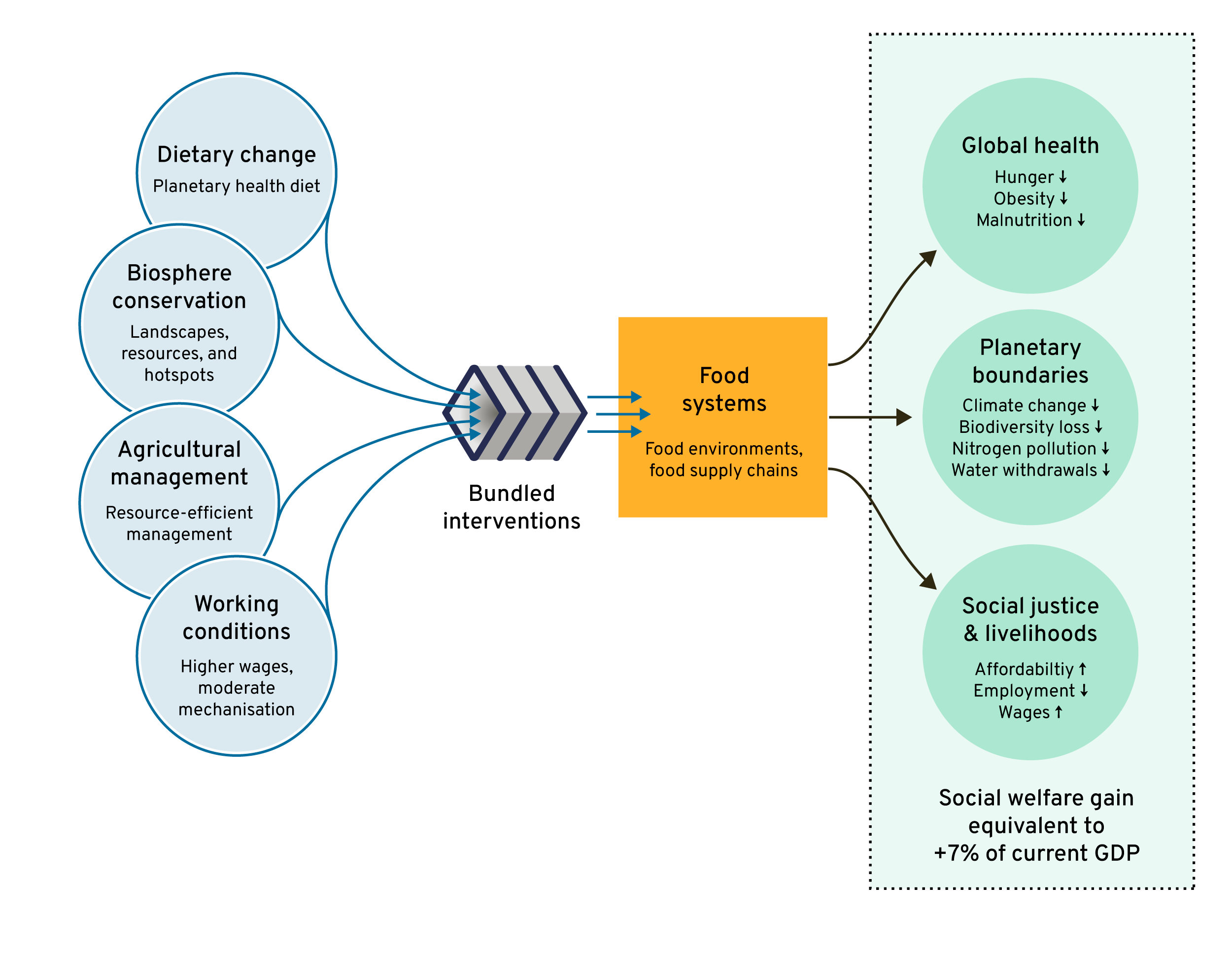
Conceptual pathway linking diverse policy objectives with co-benefits in human health, planetary boundaries, and socio-economic well-being, via bundled interventions for food systems transformation.