Key messages
- Climate obstruction refers to intentional efforts to block or slow climate action and policies. These efforts range from outright science denial to more subtle tactics focused on delay, dilution, and distraction.
- High-emissions industries have been found to fund and collude with a wide range of networks to influence media, promote climate mis- and disinformation, and shape public opinion to block climate policy action.
- Legal action is increasingly targeting climate-related disinformation, with dozens of lawsuits filed against major oil and gas companies for historical deception and delay. Legislative efforts to curb obstruction are also emerging.
Failure to act decisively on climate change is not simply a result of human nature or technological constraints; it is fundamentally a political problem. “Climate obstruction” refers to intentional efforts to slow or block climate policies that align with the scientific understanding of what is needed to avoid dangerous levels of global warming. Tactics range from outright denial of climate science to more subtle forms of delay, dilution, and distraction. Such obstruction is a central reason why decarbonisation has lagged so far behind international emissions goals.
Enabling these activities are high-emissions industries, chiefly oil and gas but also coal, utilities, carmakers, aviation, and agribusiness, along with their commercial suppliers and customers, who have funded an extensive network of trade associations, PR firms, law firms, think tanks, consultants, and university-linked researchers. Together, these actors lobby governments, make political contributions, and shape media content and research, thereby influencing public opinion and leading to climate inaction (Figure 9). As climate action has globalised, so has obstruction, with transnational networks linking actors across the Global North and South. The full extent of climate obstruction continues to emerge.
In the late 1990s and early 2000s, academics began documenting the roles of contrarian scientists, conservative think tanks, and the media. By the 2010s, investigative journalism and research into barriers to climate action had expanded significantly, and in 2022 the IPCC’s Working Group III report identified vested interests and incumbent actors as barriers to mitigation. That same year, the US House Committee on Oversight and Reform released documents showing that Chevron and BP were greenwashing to obscure their long-term fossil fuel investments. Meanwhile, the Commission on Human Rights of the Philippines found that major oil and gas producers had “engaged in wilful obfuscation and obstruction to prevent meaningful climate action”. Most recently, the Australian Senate concluded that the country’s democracy is being undermined by misinformation and disinformation on climate change and energy, often traceable to the fossil fuel industry.
As political and economic conditions evolve, so too do the tactics of climate obstruction. Outright denial of the basic science peaked before the 1997 Kyoto conference, when a successful deal would have triggered a rapid shift away from fossil fuels. Today it persists mainly among far-right voters and parties, and arguably, in continued fossil fuel expansion, which runs counter to the case for rapid decarbonisation. From the 2000s onwards, industry increasingly turned to “discourses of delay”, publicly accepting the science but blocking action by other means, such as framing regulation as economically harmful or shifting responsibility onto individual consumers.
As climate litigation and ambitious legislation have mounted in the post-Paris era, the industry has escalated a well-established strategy of promoting “false solutions” (such as algae farming and end-of-pipe carbon capture) to project voluntary climate leadership while simultaneously pre-empting stricter regulation and continuing to expand fossil fuel production. The latest phase of climate obstruction includes misleading net-zero pledges, greenwashing, and “futurewashing”: claims that lack short-term targets and are vulnerable to future retreat. Combined, these actions are designed to make voluntary corporate action appear sufficient and thus pre-empt regulation.
The channels through which obstruction reaches the public have shifted too. As mainstream media became less willing to present climate science and denial as equally credible, denial migrated to spaces with weaker editorial gatekeeping – first blogs, then social media. Platforms have profited from fossil fuel advertising and contrarian content has been algorithmically amplified with little accountability. They are also enabling “participatory misinformation”, in which ordinary users share and amplify denialist talking points engineered to exploit economic anxiety and cultural resentment. Generative artificial intelligence adds a further complication by drastically lowering the cost of producing disinformation at scale, though it may also help detect disinformation, increase the visibility of corporate conduct, and counter conspiracy beliefs.
The nature of obstruction varies with national and local contexts, as evidenced by empirical data across the Global South. In Brazil, climate denial often fuses far-right politics with Christian nationalism, echoing patterns seen in the USA. In Argentina, obstruction extends well beyond fossil fuels to agribusiness and energy more broadly, with “developmentalist” promises of a better future frequently pitched against environmental concerns. A similar dynamic plays out in Indonesia, where the palm oil and coal-mining industries are part of the government’s development agenda, slowing the shift towards renewable energy.
What is being done about all this? Alongside research into obstruction, legal action is gathering pace. Dozens of lawsuits filed by US cities and states against major oil and gas companies are ongoing, and similar cases are emerging elsewhere. Brazil leads the Global South in climate litigation, with more than 80 cases filed so far. Some cases seek damages from producers, claiming they knew the risks and downplayed them, echoing tobacco litigation; others target greenwashing claims, as recently enforced in a Parisian court ruling against TotalEnergies. Regulation is advancing too, with Amsterdam becoming the first city to ban fossil fuel advertising. Looking ahead, much more is needed to curb the political influence of carbon-intensive industries and their vast networks. Our ability to identify and remove obstructions will strongly influence the pace of climate action in the years ahead.
Policy implications
- Institutionalise UNFCCC integrity and conflict-of-interest reforms. Parties should mandate disclosure of delegate affiliations, establish conflict-of-interest frameworks, and reform observer modalities to prevent fossil fuel interests from delaying UNFCCC negotiations. COP31’s Action Agenda should establish a dedicated track on democratic governance and integrate the Global Initiative for Information Integrity on Climate Change into Action for Climate Empowerment (ACE) mandates.
- Embed anti-obstruction safeguards in NDCs and governance. To prevent “false solutions” and greenwashing from substituting for deep mitigation, integrity criteria should be considered for the NDC updates and Article 6 market mechanisms. Guidelines should require Parties to report on corporate lobbying, enforce “say–do” consistency checks, and prevent carbon offsets from delaying domestic fossil fuel phase-outs.
- Regulate corporate political influence and financial contributions from carbon-intensive industries to ensure transparency. National and subnational policymakers must target structural drivers of delay by banning deceptive greenwashing, restricting corporate lobbying and campaign contributions, and enforcing strict financial disclosures. Furthermore, regulatory oversight should extend beyond fossil producers to banks, private equity, and asset managers funding high-emissions assets.
- Reorient climate finance to neutralise obstruction in the Global South. To counter domestic political narratives that frame decarbonisation as an economic threat, MDB lending, bilateral support, and climate finance must fund low-carbon economic diversification and social safety nets, as concrete elements of just transitions.
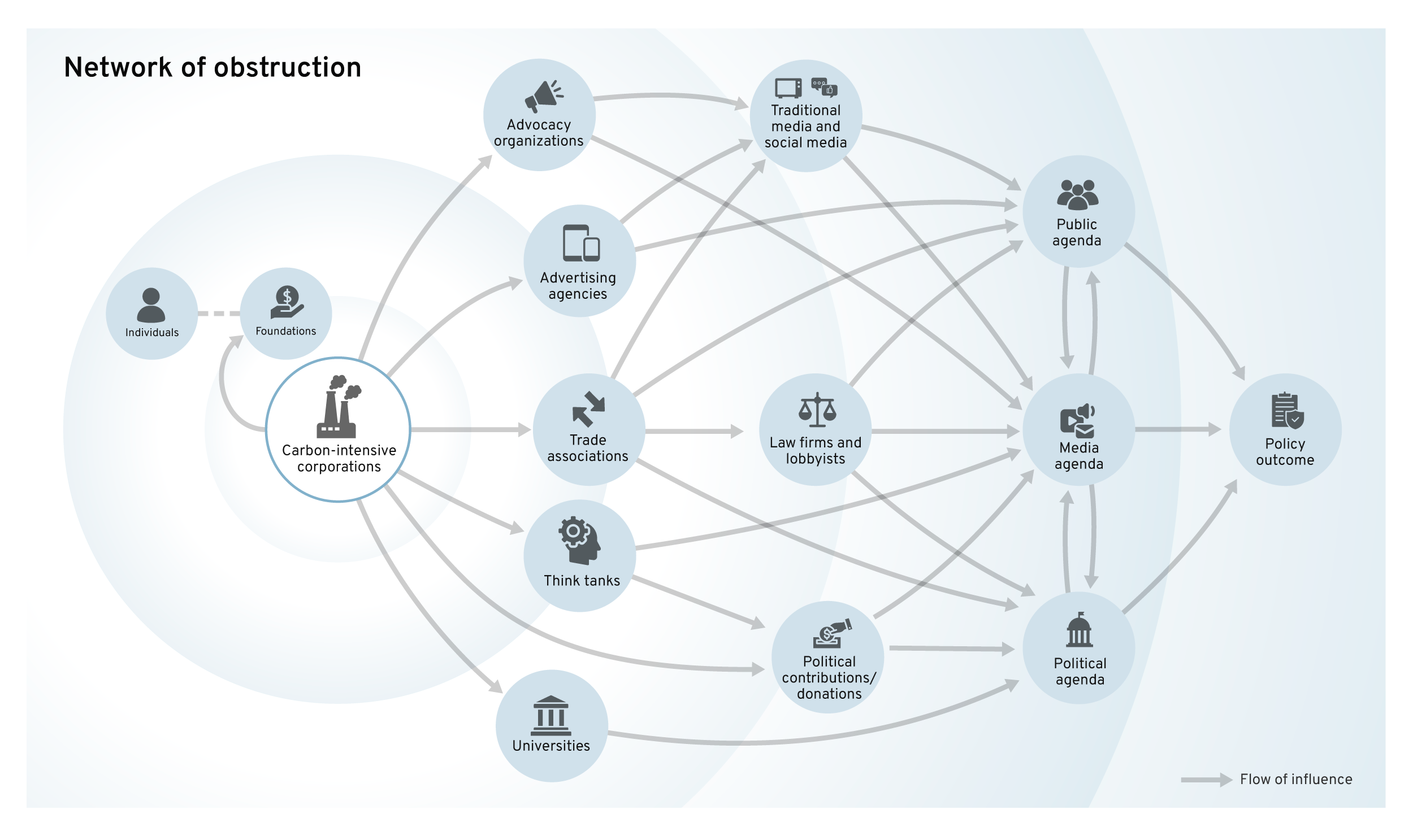
depicting the financial flows and other forms of influence stemming from carbon-intensive corporations (and the foundations and individuals associated with these), through various organisations affecting agendas, and ultimately shaping policy outcomes with the intention of obstructing climate policy. Based on Brulle (2021)1.
- Brulle, R. J. (2021). The Structure of Obstruction: Understanding Opposition to Climate Change Action in the United States. CSSN Primer. ↩