Key messages
- Global mean sea level rise (GMSLR) is accelerating, with the rate of increase doubling over the past 30 years. Thermal expansion and freshwater input from the cryosphere are the primary drivers.
- Glacier melt was the largest single contributor to sea level rise over the 20th century, but over recent decades thermal expansion has been the largest single contributor. Looking ahead, the Greenland and Antarctic ice sheets combined are expected to become the largest individual contributor to sea level rise by the end of the 21st century.
- Cumulative greenhouse gas emissions in the coming decades will lock in irreversible sea level rise for centuries to come. Stringent emission mitigation could still avoid a substantial fraction of the additional sea level rise projected by 2300 under current policies.
- A major source of uncertainty in sea level rise projections stems from tipping points and irreversible ice retreat. Evidence suggests that marine-based sectors of both major ice sheets may have already undergone irreversible change at current warming levels, potentially committing certain outlet glaciers to large-scale, self-sustained retreat.
An estimated one billion people live in coastal areas less than 10 m above sea level, and recent research suggests they face greater exposure to sea level rise than previously thought. Predicting the extent of this rise has never mattered more. Decisions made in the coming decades will shape coastal risks for generations.
GMSLR has accelerated during the 21st century, with the rate doubling in the past 30 years. This change has not been slow and steady. Research shows a step-like increase in the rate of sea level rise in the early 2010s, linked to natural fluctuations in the climate system, which exacerbated the human-induced baseline trend.
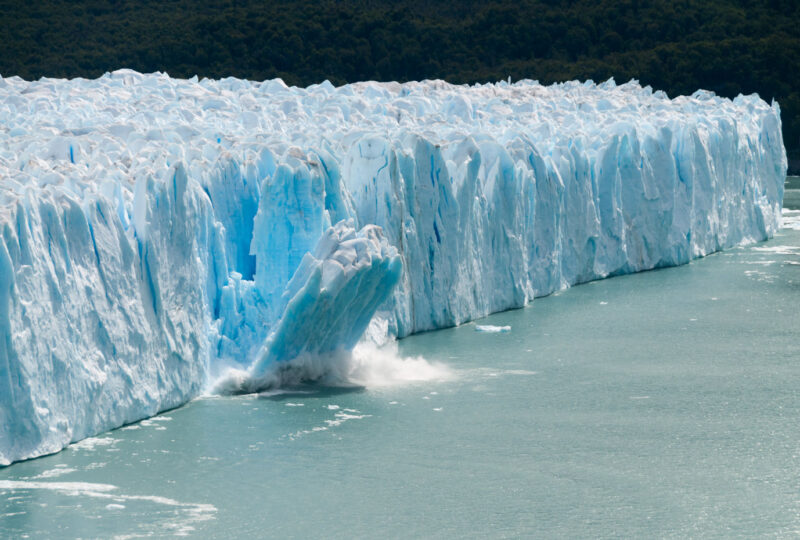
Sea levels have been rising over the long term due to thermal expansion and freshwater from melting glaciers and the Greenland and Antarctic ice sheets. In recent decades, the contribution from glaciers has become increasingly prominent: they have added around 25 mm to global mean sea level since the mid-1970s, out of a total rise of 73–146 mm between 1971 and 2018. For perspective, global glaciers have recorded an ice mass loss almost 20% larger than that of the Greenland ice sheet and double that of the Antarctic ice sheet since 2000.
Irreversible change is already locked in. Recent estimates suggest global glaciers could lose up to 39% of their mass, adding roughly 113 mm to global sea level in the long term, even without further warming. Should warming continue, that figure could climb to 230 mm. Although glacier melt is likely to remain significant in the near term, future rise is expected to be increasingly influenced by the melting of the large polar ice sheets in Greenland and Antarctica (Figure 2). By 2100, Greenland’s ice sheet could add between 320 mm and 900 mm to sea level, while the Antarctic ice sheet melt could contribute anywhere between -78 mm and +300 mm.
Much of this uncertainty stems from how these dynamical processes unfold over centuries, as model choices and starting conditions can produce widely varying outcomes. Whether or not we hit tipping points in the unstable retreat of melting ice will have major implications, particularly for the Greenland and Antarctic ice sheets, which are both drained by ice streams prone to instability. But science is advancing. Recent modelling breakthroughs that better match today’s observed mass changes have boosted confidence in ice-sheet projections and sharpened understanding of instability within parts of the land ice. Palaeoclimate evidence adds another layer: it suggests the marine sectors and margins of these ice sheets may already have crossed nonlinear or irreversible thresholds at warming levels close to today’s, or may do so within this century. This has fuelled debate over whether some ice streams are already locked into, or fast approaching, large-scale, self-sustaining retreat.
It is clear that ice sheets and glaciers respond slowly to global warming. Therefore, crossing thresholds in cumulative greenhouse gas emissions locks in irreversible sea level rise for centuries to come. Greenhouse gas emissions in the coming decades can be linked to multi-century global and regional sea level rise through a recent modelling framework based on the Shared Socioeconomic Pathways (SSPs) assessed in the IPCC AR6. Under a continuation of current climate policies (SSP2-4.5, Figure 2), emissions up to 2050 would lock in 300 mm of additional global mean sea level rise by 2300, on top of what historical emissions to 2020 have already triggered. Extend that policy trajectory to 2090, and the commitment grows to 800 mm. Alternatively, switching to the stringent mitigation pathway consistent with the Paris Agreement (SSP1-1.9) could avoid around 600 mm of that 800 mm rise. Under a very high emissions scenario (SSP5-8.5), the model projects a likely Antarctic sea level rise contribution of 4,700 mm to 10,500 mm by 2300, including ice-shelf collapse.
The prospect of these locked-in changes underlines the urgency of near-term mitigation and the need to better understand future sea level response. It also highlights why limiting peak warming matters and why relying on uncertain future cooling of global temperatures is risky. Even if global temperature rise could be reversed, long-term sea level rise cannot be undone on human timescales, making effective adaptation essential for impacts that are now unavoidable. Assessing coastal vulnerability means going beyond the global average; it requires accounting for regional variation in sea level rise and using accurate estimates of coastal land elevation. Recent studies suggest coastal populations’ exposure has been consistently underestimated. For highly vulnerable countries such as Small Island Developing States, effective adaptation planning grounded in precise physical risk data and local context is essential to reduce severe impacts on economic and social infrastructure, livelihoods, human health, and security, affecting millions of people.
Above all, to slow sea level rise and avoid locked-in rises of several metres, sustained global reductions in greenhouse gas emissions must start immediately. A climate-resilient future requires a dual response: immediate mitigation paired with effective, equitable adaptation.
Policy implications
- Emphasise long-term sea level commitments to accelerate implementation and mobilise higher ambition. Parties should strengthen and implement their 2035 NDCs using multi-century sea-level assessments to communicate the consequences of delayed emissions cuts, and increasing risks of irreversible changes (see Insight 4). The Ambition on Melting Ice coalition, a 25-nation ministerial-level group, could spearhead this message through a joint COP31 ministerial statement and coordinated engagement with the COP Presidencies.
- Embed dynamic adaptation pathways in NAPs. Implement near-term measures, preserve future options, and monitor agreed indicators that trigger action before existing measures become inadequate. Planners should combine local sea-level projections, elevation, and land-motion data, and stress-test long-lived infrastructure against plausible high-end scenarios. Adaptation plans for areas vulnerable to sea level rise should use the best available regional projections to guide near-term preparedness, land-use planning, and relocation planning.
- Deliver loss-and-damage finance for slow-onset sea-level impacts. Increasing resources for the FRLD and support for its first replenishment process, starting in 2027, are critical. The Board and Secretariat of the FRLD should work towards ensuring that application and assessment procedures accommodate slow-onset impacts, including permanent land loss, loss of livelihoods, and non-economic losses. Governments of vulnerable Small Island Developing States and delta countries should develop country-led requests with affected communities, including support for safe, dignified mobility where needed.
- Strengthen coastal observations and warnings where capacity is weakest. Governments and space agencies should sustain tide-gauge, satellite, and vertical-land-motion monitoring, prioritising countries with limited observational capacity and supporting the Global Sea Level Observing System. Observing agencies should share quality-controlled records consistent with Global Climate Observing System requirements.
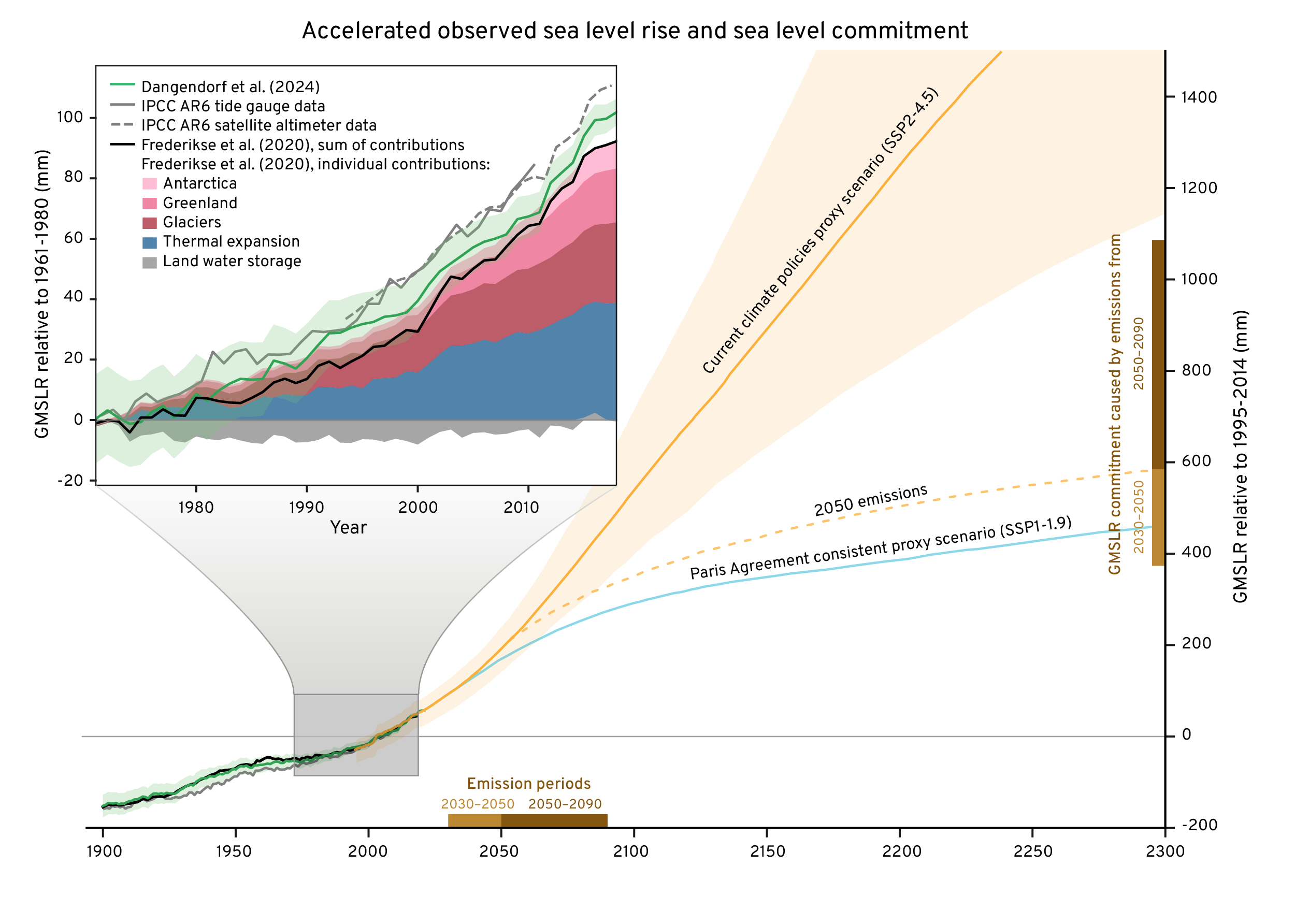
IPCC Sixth Assessment Report (AR6) historical GMSLR data (dark grey, central estimate) and reconstructions.1 GMSLR projections2 under SSP2-4.5 as a current climate policy proxy scenario (solid orange, median and 66% model range) and the locked-in GMSLR commitments from corresponding SSP2-4.5 cumulative greenhouse gas emissions in 2050 (dashed orange, median); and median SSP1-1.9 projection as a proxy for a Paris Agreement-consistent scenario (solid light blue). All data are provided in mm relative to 1995–2014. Brown bars indicate illustrative 2030–2050 and 2050–2090 emission periods and the resulting GMSLR commitments by 2300.
Inset: Stacked sea level budget in mm relative to 1961–1980 based on Frederikse et al. (2020), showing individual contributions from thermal expansion (blue), glaciers (light red), Greenland (red), Antarctica (dark red), and land water storage (grey), as well as the sum of contributions (black line). Also shown are the Dangendorf et al. (2024) reconstruction (green, central estimate and 95% confidence range), and central estimates from IPCC AR6 tide gauge (solid dark grey line) and IPCC AR6 satellite altimeter records (dashed dark grey line).
- Frederikse, T., et al. (2020). The causes of sea-level rise since 1900. Nature, 584(7821), 393–397; and Dangendorf, S., et al. (2024). Probabilistic reconstruction of sea-level changes and their causes since 1900. Earth System Science Data, 16(7), 3471–3494. ↩
- Nauels, A., et al. (2025). Multi-century global and regional sea-level rise commitments from cumulative greenhouse gas emissions in the coming decades. Nature Climate Change, 15(11), 1198–1204. ↩